
77 winters · 9 sites · 0 defects
A record signed by an independent Engineer of Record

The record in numbersLL-TEQ™ freeze-thaw performance
9 reference sites in real service, across 4 climate regimes comparable to Québec
The Québec freeze-thaw challenge
The dominant pavement-degradation mechanism in Québec
In Québec, conventional bituminous pavement ages under two compounding pressures: thermal fatigue from repeated freeze-thaw cycles around 0 °C, and structural heave caused by the formation of ice lenses in the frost-susceptible clay soils of the St. Lawrence Lowlands.
Under a humid continental Dfb climate — roughly 75 freeze-thaw cycles per year and more than 2 metres of snow — shrinkage cracks, alligator cracking, potholes and rutting advance season after season. Corrective maintenance becomes the dominant road-spending line item.
The question put to LL-TEQ
Can a pavement system that delivers both the wearing course and the structural function at once, formed in place as a single monolith, withstand Québec winter conditions durably?
The dossier's answer
9 reference sites in real service across the United States, under 4 climate regimes comparable to Québec's Dfb, totalling 77 cumulative winters and roughly 6,730 freeze-thaw cycles: no defect attributable to the freeze-thaw cycle was observed by the Engineer of Record in April 2026.
The dossier at a glance
An empirical performance record signed by an independent engineer
This document is the marketing summary of the technical dossier "LL-TEQ — Freeze-Thaw Performance," dated May 19, 2026 and prepared by an independent engineer at LL-TEQ's request.
Mark D. Hardy, P.E.
Engineer of Record, Hardy Engineering, Santa Monica (CA). Professional licence PE 36538.
In-service visual inspection
Methodical assessment over the full treated length of all 9 sites, aligned with the principles of ASTM D6433. Inspections completed in April 2026.
Documentary record
An empirical record of observed performance. Project-by-project design remains the responsibility of the design engineer.
The question asked of each site
On in-service visual inspection by a qualified engineer, is any pavement defect attributable to freeze-thaw observed — cracking, alligator cracking, heave, potholes, rutting or slippage cracking?
Why LL-TEQ does not crack under freeze-thaw
A cohesive layer with no bituminous matrix, no interface, no connected pores
Freeze-thaw degradation of a flexible pavement relies on specific physical enablers. LL-TEQ provides none of them.
Nothing to harden, nothing to crack
LL-TEQ uses no bituminous binder subject to ageing and hardening. Cyclic thermal stresses find no brittle matrix to act upon.
Water does not enter, freezing does not start
The layer's dense cohesion eliminates connected porosity and capillary retention. With no free water in the matrix, no ice lens can form inside the layer.
One structure, one monolith
The layer is formed in place as a unified whole, with no stratification or adhesive plane. No interface where differential stresses could concentrate.
The fine fraction enters the monolith
The upper fraction of the native soil is integrated into the cohesive matrix. The mass of fine soil able to form ice lenses in direct contact with the layer is reduced at the source.
The two freeze-thaw degradation mechanisms*
M1 — cyclic thermal fatigue · M2 — structural heave from deep frost
* Two-mechanism framework established by the Engineer of Record in the technical dossier's scoping note (§3.3), aligned with the ASTM D6433 inspection grid.
LL-TEQ neutralizes both at the source
M1 — no bituminous matrix to harden, no interface where stress concentrates. M2 — no internal slip plane, and the upper fraction of the native soil is integrated into the cohesive monolith. Both mechanisms remain without physical support in the LL-TEQ structure.
How it is built
Two cold-application techniques, conventional road equipment
The dossier's 9 sites were built using two distinct techniques, both of which produce a unified cohesive layer delivering both the wearing surface and the structural function.
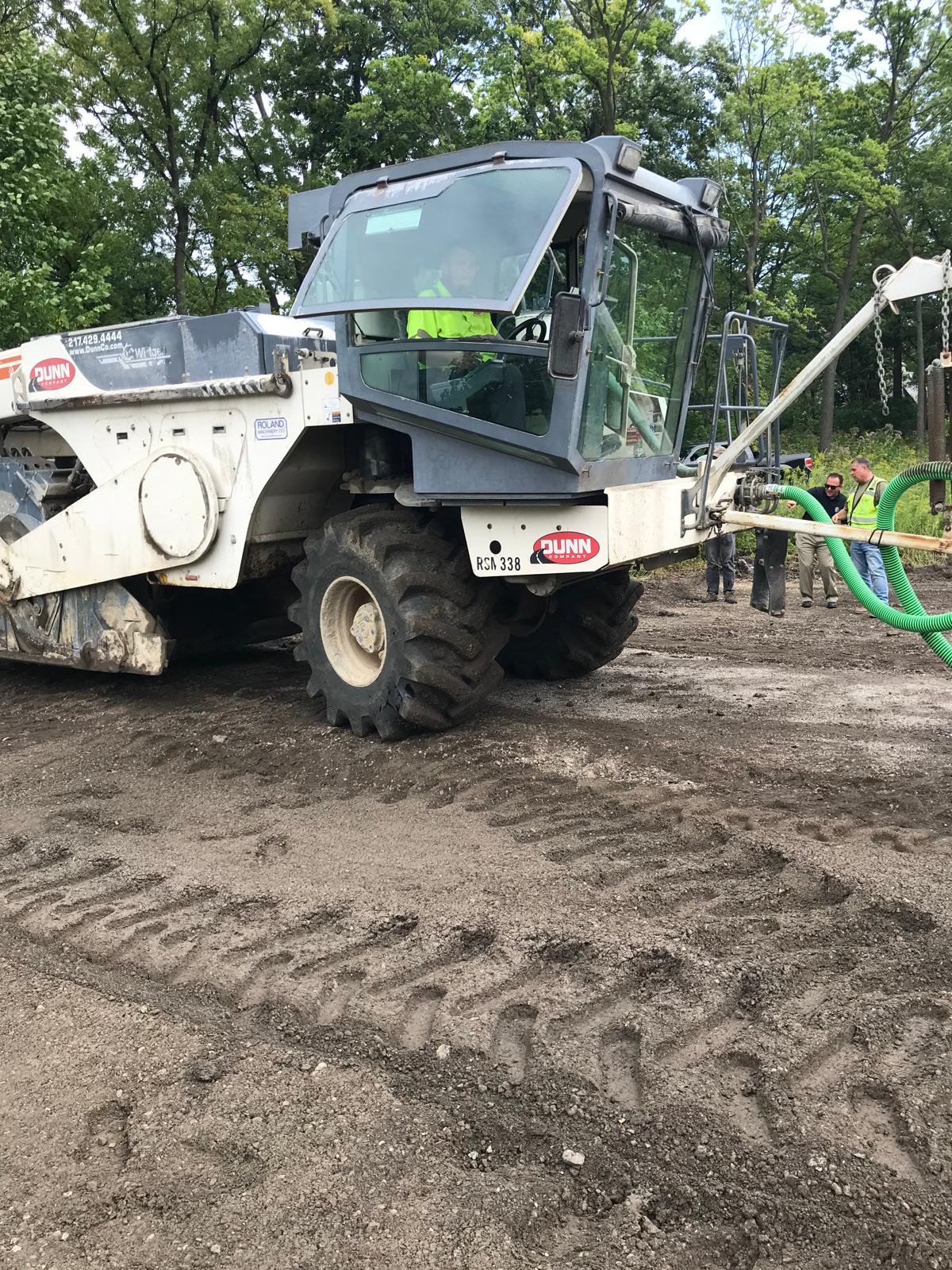
Cold recycling in place (Cold Recycling)
Four sites treated: Benton Harbor, Alexandria, Glenview, Bessemer. The reclaimer integrates the existing degraded bituminous mix and the underlying granular gravel base into a cohesive layer of ≈150 mm (6 in), with no interface or stratification.
Use case: rehabilitation of an existing degraded pavement.
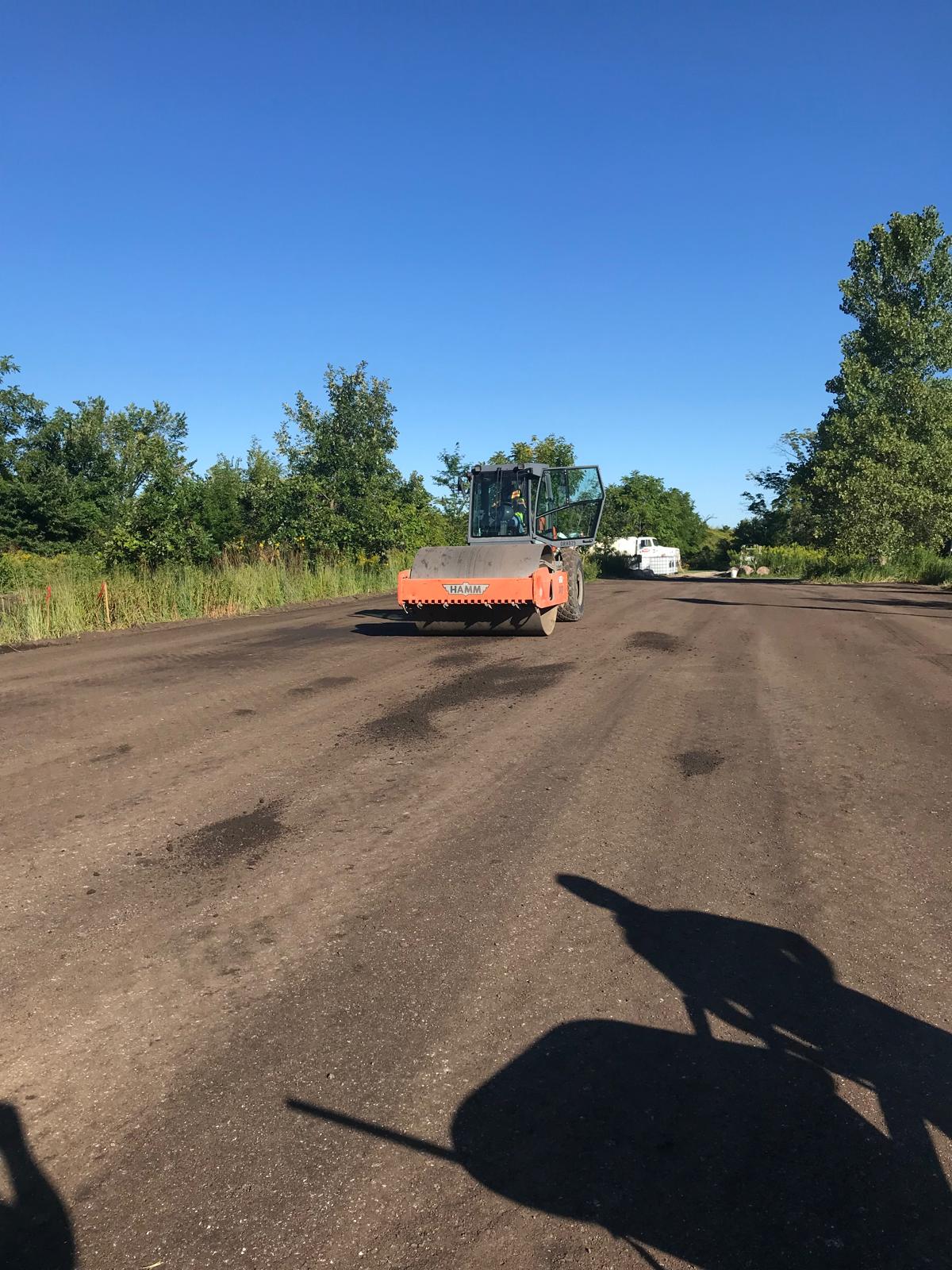
In-place native-soil stabilization (In-place Soil Stabilization)
Five sites treated: Rockford, East Chicago, Elgin, Bridgeport, Big Bear Lake. The LL-TEQ layer alone constitutes the pavement, at ≈150 mm (≈200 mm at Bridgeport for the dossier's most demanding load). No added granular base or sub-base.
Use case: new pavements with no prior conventional structure.
The 9 reference sites — 77 winters, 0 defects
Visual inspections signed by the Engineer of Record in April 2026
| # | Site, State | Köppen | Winters | Road category | Freeze-thaw verdict |
|---|---|---|---|---|---|
| 1 | Benton Harbor, MI | Dfa | 9 | Local (municipal, lake effect) | 0 defects |
| 2 | Alexandria, VA | Cfa | 9 | Local (Potomac marine clay) | 0 defects |
| 3 | Rockford, IL | Dfa | 8 | Collector (heavy haul) | 0 defects |
| 4 | Glenview, IL | Dfa | 8 | Local (park access, silty soil) | 0 defects |
| 5 | East Chicago, IN | Dfa | 8 | Arterial (industrial corridor) | 0 defects |
| 6 | Elgin, IL | Dfa | 8 | Collector (heavy haul) | 0 defects |
| 7 | Bridgeport, CA | Dsb | 10 | Arterial (military airstrip, 2,070 m) | 0 defects |
| 8 | Big Bear Lake, CA | Csb | 7 | Local (mountain access, 2,050 m) | 0 defects |
| 9 | Bessemer, AL | Cfa | 10 | Local (the oldest — 10 winters) | 0 defects |
Site-by-site detail (climate, soil, weather events endured, cumulative ESALs, documented interventions) in the full technical dossier, available on request.
Flagship site — Bessemer, Alabama
10 winters of service — the oldest site in the dossier
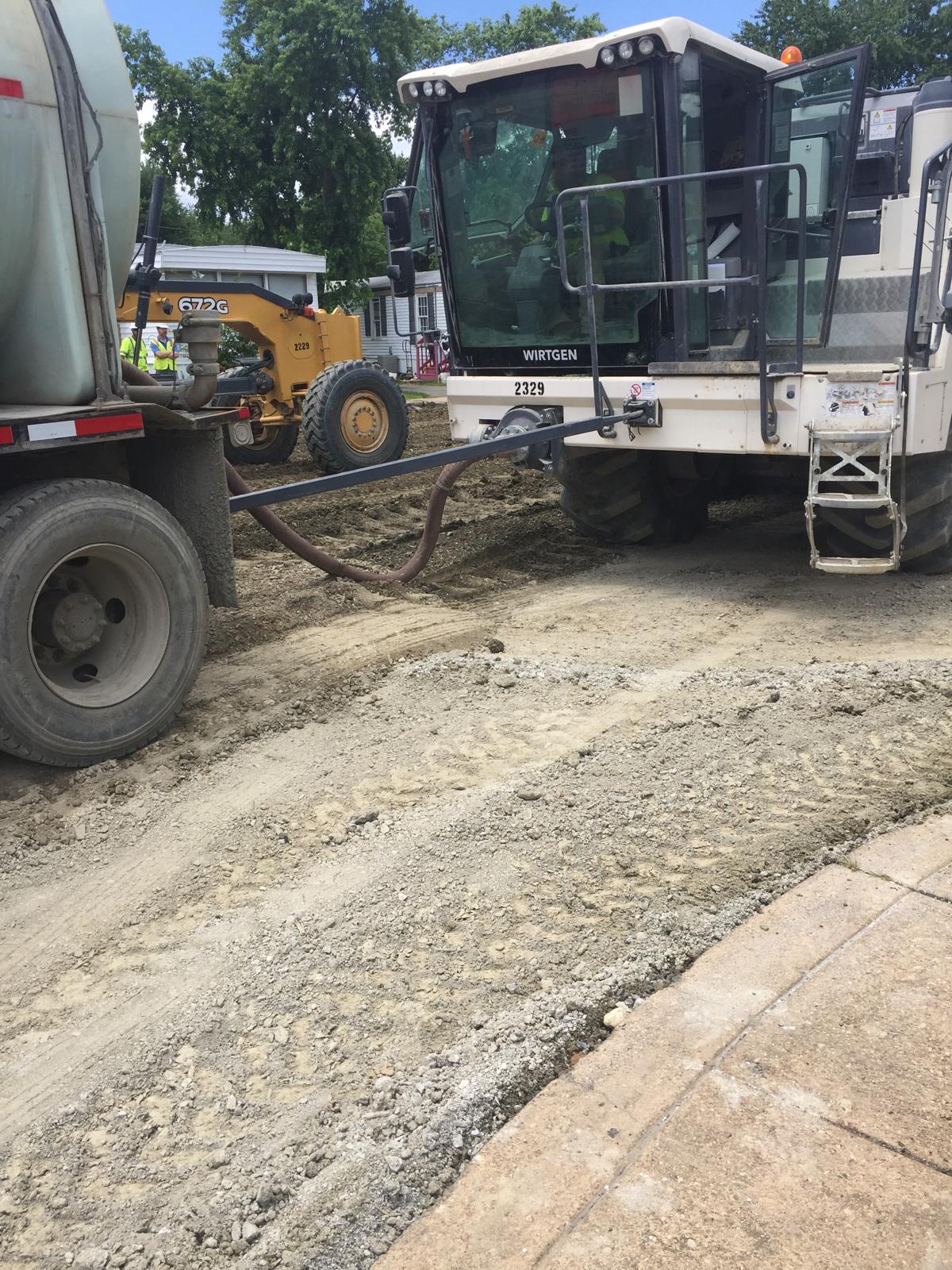
Why this site matters
Placed in service in April 2016 by cold recycling in place. 10 cumulative winters, humid subtropical climate (Cfa), ~1,300 mm/yr rainfall and silty native soil. The pairing of moisture + fine soil documents LL-TEQ's long-term durability under a regime with frequent oscillations around 0 °C.
Events endured
- EF3 tornado, January 2021 (~240 km/h, Jefferson County)
- Flash flooding, March 2022 (~130 mm in a few hours)
- Arctic cold snap, December 2022
April 2026 finding (10 winters)
No cracking, no alligator cracking, no heave, no potholes, no rutting. Surface wear "slight for ten winters of exposure."
Flagship site — Glenview, Illinois
8 winters — silty soil comparable to the loose deposits of the Lowlands
Why this site matters
Placed in service August 2018. Access infrastructure in a wooded riverside recreational area, Cook County. 8 winters, humid continental climate (Dfa), silty floodplain soil — comparable to the loose deposits of the St. Lawrence Lowlands.
Relevance to Québec
The site documents LL-TEQ's performance on a fine substrate susceptible to frost heave and to bearing-capacity loss on thaw — exactly the soil profile that troubles conventional pavements in the Lowlands.
April 2026 finding (8 winters)
No cracking, no alligator cracking, no heave, no potholes, no rutting. Cohesion intact over the full treated length.
Flagship site — Bridgeport, California
Military airstrip, C-17 Globemaster III, 265 tonnes — with no conventional structure
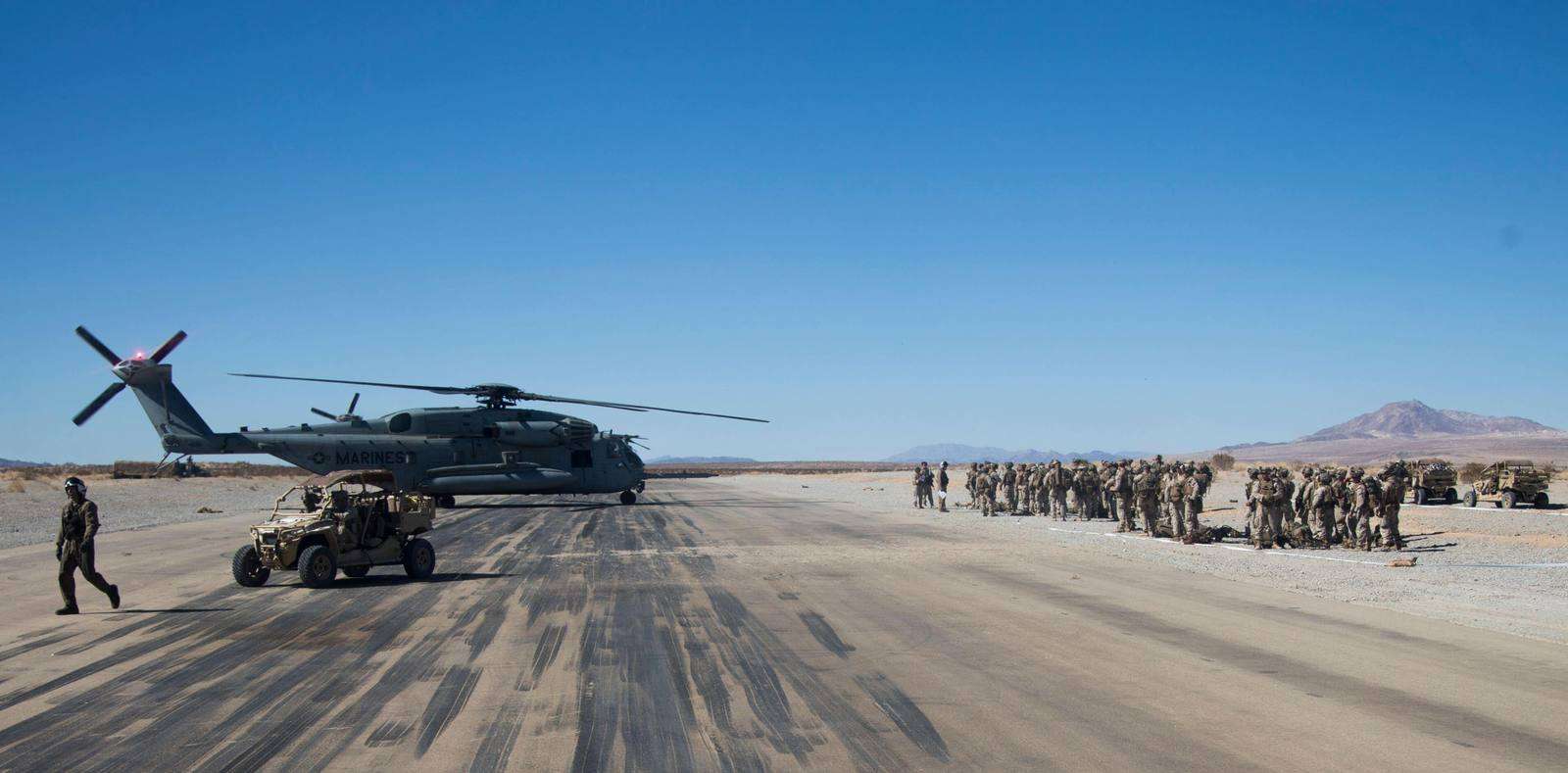
Why this site matters
Placed in service July 2016 by in-place native-soil stabilization over ≈200 mm (8 in), with no prior conventional structure whatsoever. Airstrip at 2,070 m elevation, eastern slope of the Sierra Nevada, Dsb climate — ~172 freeze-thaw cycles/yr, more than double the Québec regime.
The documented load
Hosts in real service the C-17 Globemaster III — maximum takeoff mass ~265,000 kg. A load regime that exceeds, by a substantial margin, any load encountered on civilian road networks.
April 2026 finding (10 winters, 1,720 cumulative cycles)
No defect attributable to the freeze-thaw cycle. Integrity preserved under military aviation loading and prolonged mountain winters.
Climates compared to Québec
4 Köppen regimes neighbouring the Dfb of the St. Lawrence Lowlands
The dossier's 9 sites span four distinct Köppen climate regimes, all comparable — on the dominant parameters of freeze-thaw degradation — to the Dfb regime of the St. Lawrence Lowlands (Montréal reference).
| Köppen regime | Dossier sites | Relevance to Québec |
|---|---|---|
| Dfa — humid continental | Benton Harbor, Rockford, Glenview, East Chicago, Elgin | Direct neighbour of Québec's Dfb; comparable freeze-thaw cycles and winters, frost-susceptible fine soils |
| Cfa — humid subtropical | Alexandria (VA), Bessemer (AL) | Heavy rainfall + expansive clay soils (Alexandria: Potomac marine clay, analogous to Champlain clays) |
| Dsb — high-altitude continental | Bridgeport (CA) | ~172 freeze-thaw cycles/yr — more than double Québec's Dfb regime |
| Csb — mountain Mediterranean | Big Bear Lake (CA) | ~153 freeze-thaw cycles/yr, high-mountain daily thermal swing |
Dfb reference — Montréal
≈75 freeze-thaw cycles per year, ≈210 cm of annual snowfall. Five dossier sites exceed that annual cycle count; two exceed it by a wide margin (Bridgeport, Big Bear Lake).
Empirical corroboration — 11 years of continuous exposure
10 LL-TEQ Proctor specimens, Highland Park (Illinois), July 2015 → April 2026
In July 2015, ten LL-TEQ-treated Proctor specimens — split across four distinct matrices (asphalt, limestone, clay, sand) — were placed in continuous open-air exposure at Highland Park (Illinois), in a humid continental Dfa climate.
11 years later — April 2026 visual examination
None of the ten specimens shows any cracking, whether thermal, structural or shrinkage. Under climatic loading alone — freeze-thaw cycles, seasonal thermal variations, precipitation, radiation — the LL-TEQ layer develops no cracking.
This observation corroborates the finding from the 9 in-service sites: the surface wear noted on in-service pavements is attributable to operational loading (traffic, winter-maintenance equipment, studded tires), and not to the freeze-thaw cycle.
Statement of the Engineer of Record
Mark D. Hardy, P.E. — Hardy Engineering, Santa Monica, California
"I, the undersigned, Mark D. Hardy, engineer, in my capacity as Engineer of Record for Hardy Engineering, attest that I prepared or supervised the preparation of this master freeze-thaw performance dossier for the LL-TEQ system. The dossier brings together 9 reference sites in real service, spread across 6 US states and 4 Köppen climate regimes (Dfa, Dsb, Csb, Cfa) comparable to the Dfb regime of the St. Lawrence Lowlands, totalling 77 cumulative winters and 6,730 freeze-thaw cycles."
"The assessments rest on the in-service visual inspection of each pavement, conducted by a qualified engineer per the principles of ASTM D6433. No defect attributable to the freeze-thaw cycle under the six-category grid was observed on any of the 9 sites."
Mark D. Hardy, P.E. — Engineer of Record, Hardy Engineering · Professional licence PE 36538 · Statement dated May 19, 2026.
The English version, signed and sealed by the Engineer of Record, is the official document of record.
Going further
The full technical dossier, on request
This summary gives the result. The full technical dossier is available on request for evaluation by your engineering team: signed scoping note, 9 detailed site sheets (climate, soil, weather events, ESALs, interventions, finding), behavioural synthesis by mechanism, Highland Park empirical corroboration, and the statement of the Engineer of Record (signed official English version).
Québec, QC G1N 4H5, Canada